
Emerging Professional Spotlight

Meet Margaret Morgenstern, an Architectural Designer based in Juneau, Alaska, whose passion for intentional design, community engagement, and youth outreach is helping shape the future of architecture in Southeast Alaska through their work at MRV Architects and their leadership as the AIA Alaska Southeast Section Chair.
Q: Who are you, and what’s your current role?
A: My name is Margaret Morgenstern, and I’m an Architectural Designer with MRV Architects in Juneau. I also serve as the AIA Alaska Southeast Section Chair.
Q: What inspired you to pursue architecture?
A: My love for architecture started in 3rd grade with a project designed by the Frank Lloyd Wright Foundation. We were given characters with unique personalities and space needs, along with plans of FLW homes with all the interior walls removed. Our task was to design the spaces to fit those households. I was captivated—not just by solving the puzzle, but by shaping the pieces themselves and seeing the final image come to life. That creative spark never left.
Q: What has your journey looked like so far? Any defining moments or turning points?
A: Because I discovered architecture so young, much of my early life was focused on getting into a school that aligned with the kind of architect I wanted to become. Once I got there, I realized I needed to stop mapping out every next step and allow myself to wander for a while. That openness is what ultimately led me to walk into the MRV office on a vacation—just to chat—which turned into an opportunity that brought me to Juneau. That moment changed the trajectory of my life and career.
Q: Share a recent project you’re proud of.
A: The OVK Tribal House, currently under construction, is the first project I’ve had the chance to follow from design through construction administration. It has been an enormous learning experience and reflects many of the values I hold as a designer.
Q: Any career highlights or recognitions?
A: This year, our Southeast Section hosted our first Summer Architecture Camp. Sixteen middle and high school students partnered with local design professionals to create kayak rack and pavilion concepts for the Juneau Seawalk. We toured the site, explored plans, sections, elevations, scales, and real-world constraints, and ended the day with a pin-up where students presented to their families and community members.
When I stepped into the Section Chair role, I wanted to bring more youth into architecture—especially in a region without school drafting programs. Early exposure is essential for building diversity within the profession, so we made the camp free and accessible. It’s one of the efforts I’m most proud of.
Q: What does being an emerging professional mean to you?
A: This stage of my career feels both incredibly exciting and undeniably exhausting. There is still so much to learn, but there’s also a growing confidence in knowing the right questions to ask. It mirrors the design process—iterative, challenging, and full of discovery—and it deepens my connection to the work.
Q: What drives your work and growth?
A: I see architecture as an artistic response to human need. Throughout history, people have created beauty in the spaces and objects meant for even the most basic functions, and that inspires me. In an era where design intention can be overshadowed by cost-cutting, I strive to educate clients about the importance of the messages our buildings send. Whether we mean to or not, our work shapes the built environment and affects everyone who encounters it. I take that responsibility seriously.
Q: How do you hope to impact the profession?
A: My thesis, Queer Spaces, explored ideas from Eve Kosofsky Sedgwick’s Epistemology of the Closet, specifically the notion that denying someone the ability to self-identify is a profound form of violence. Architecture, by nature, requires us to make assumptions about our users—an inherent contradiction.
My hope is to bring more intention to how we design for representation. Instead of aiming for universality, I want to design with specificity, helping clients see the value in creating spaces that honor particular identities while welcoming others into new perspectives.
Q: What advice would you give to others just starting out?
A: There truly is no such thing as a dumb question. Trying to solve things independently is important, but there’s a moment when productive struggle becomes unnecessary suffering. Learning to recognize that point—and feeling unafraid to ask for help—is an invaluable skill.
Q: Favorite design style or architect?
A: Gothic cathedrals have always held a special place in my heart—their beauty, grandeur, and communal craftsmanship are endlessly inspiring. But I also love a smartly designed coffee shack.
Q: A fun fact about you?
A: I cross-stitch! My first piece took me two years and more than 100,000 stitches. I’m now working on a series of vintage salmon can labels and have nearly four finished.
Margaret’s story highlights the curiosity, intentionality, and deep sense of responsibility that define today’s emerging professionals. Their dedication to thoughtful design and meaningful community engagement reflects the future of architecture in Alaska—one built with care, purpose, and connection.
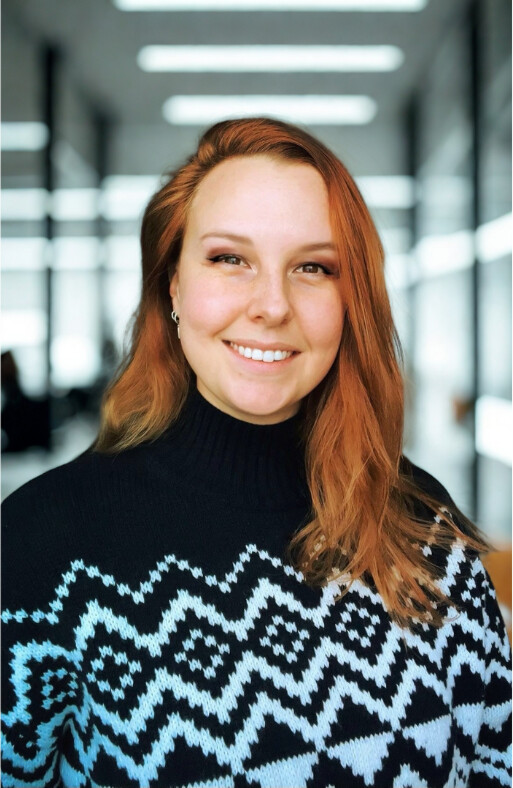
Meet Genevieve Beloin, an architectural associate based in Fairbanks, Alaska, whose creative vision and hands-on approach are helping shape the built environment of her community through her work at Bettisworth North.
Q: Who are you, and what’s your current role?
A: My name is Genevieve, and I am an architectural associate at Bettisworth North. I also serve on the AIA Alaska Board as the Northern Section Chair.
Q: What inspired you to pursue architecture?
A: I was drawn to architecture through the creative atmosphere I grew up in. My dad worked as a carpenter and my mom as a seamstress and small business owner. Our home was a constant workshop of hands-on projects, from home improvement and garden beds, to cutting sewing patterns and experimenting with textiles. Watching my parents shape environments and objects with care and craftsmanship sparked my own fascination with how space, structure, and material come together. Their influence made design feel both approachable and deeply personal as a way of life rooted in creativity and making.
Q: What has your journey looked like so far? Any defining moments or turning points?
A: My journey into architecture began before I started high school. Knowing early on what path I wanted to follow, I was intentional with selecting classes that would support foundational skills needed to eventually pursue an architectural degree. I was fortunate that my high school offered career center electives aligned with my interests, and I took full advantage by immersing myself in courses that explored design, art, history, and technical drawing. That commitment ultimately led to my recognition as a member of the National Arts Honor Society, which felt like the affirmation that I was on the right track towards a creative and purposeful future in architecture.
Upon entering college as an architecture student was when my exploration in the field exploded even more. I had a mix of jobs between construction materials testing, and working as an intern at a design-build architecture firm. I often like to say, I learned a lot about architecture from the ground up, considering I spent a lot of time testing and studying the strength and material capacities of soils, gravels, concrete, rebar, and steel.
One particularly special defining moment was taking the leap, after graduating from college in Boston, to move to Alaska and seek employment. After the culmination of all the education and experience I had acquired at that point, I knew the climate and the culture were exactly where I wanted to be immersed as I started my career. And I’m still here, 10 years later!
Q: Share a recent project you’re proud of.
A: A recent project I’m especially proud of is the Physical Readiness Fieldhouse at Fort Wainwright, where I served in both a project manager and designer capacity. As a design-build project with a highly accelerated schedule, it required the delivery of multiple design packages in rapid succession. The coordination efforts were intense, but through clear communication and trust, the design team evolved in what I can only describe as a well-oiled machine. Decisions were made constantly and collaboratively, demanding a high level of agility and efficiency, particularly in Revit. It was a project that pushed my skills and reinforced the power of adaptability, teamwork, and precision in fast-paced design environments.
Q: Any career highlights or recognitions?
A: One of the greatest highlights of my architectural journey has been the privilege of living and working in Alaska. While not originally from this state, my time here has been an ongoing adventure that is rooted in curiosity, learning, and culminating a deep appreciation for the Alaskan landscape and its communities. Through traveling across the region, listening to the stories of others, and collaborating with diverse design teams, I’ve developed a strong foundation that is focused on an expertise in northern design. Carving out my own Alaskan experience, both personally and professionally, has shaped my perspective and strengthened my work. It’s a place that continually challenges and inspires me, and being a steward of its built environment feels both humbling and rewarding.
Q: What does being an emerging professional mean to you?
A: To me, being an emerging professional in architecture represents a powerful in-between, beyond the uncertainty of starting out, but not yet at the threshold of senior leadership. It’s a space filled with momentum, where growth and learning are constant, and where you’re trusted with a certain level of responsibility while still discovering the power of your own voice. It’s a time to explore, take part in the various experiences that resonate most deeply, and to ask the important questions like, “How do I want to make a difference with the work that I do?” This stage is both grounding and energizing, offering a chance to refine your purpose while contributing meaningfully to the profession.
Q: What drives your work and growth?
A: What drives my work and growth is a mindset rooted in my college studio experience—the late nights, the relentless problem solving, and the camaraderie built with peers who pushed and supported one another. That student persona, defined by curiosity, resilience, and the refusal to settle, never really leaves you. It becomes a habit that fuels a constant desire to stay engaged, stay relevant, and keep striving for more. That drive to evolve, to seek better solutions, and to stay hungry for the craft is what continues to shape me as a designer and keeps my passion for architecture alive.
Q: How do you hope to impact the profession?
A: I hope to impact the profession by upholding a design ethic rooted in care, reverence, and responsibility. Early in my education, I read The Hand and the Soul: Aesthetics and Ethics in Architecture and Art, a collection of essays that explore how ethical ideas guide our design processes, particularly in relation to the environment, cultural preservation, and social justice. One quote by W.G. Clark has always stayed with me:
“We want our artifacts and habitats, like those of the civilizations we admire, to form an allegiance with the land so strong that our existence is seen as an act of adoration, not as an act of ruin.”
That message continues to shape how I see my role in the built environment. I strive to design with intention, to honor the landscapes and communities we build within, and contribute to a lasting legacy of thoughtful, respectful architecture.
Q: What advice would you give to others just starting out?
A: If I could offer advice to someone just beginning their journey in architecture, it would be to follow your personal interests, whatever they may be. Whether it’s technology, software, planning, history, detailing, volunteering, advocacy, building systems, or material studies, let those curiosities guide you.
Architecture is a vast and sometimes overwhelming field, and it’s easy to want to compare yourself to what others are doing. But don’t be afraid to look inward. The questions you ask and the passions you carry are worth pursuing. They’re not only valid, but they’re the foundation of your unique perspective and contribution to the profession. Trust that your individuality and personal expertise are strengths, and use them as a tool to shape your path forward.
Q: Favorite design style or architect?
A: My favorite architect is Renzo Piano, so much so that I named my cat Renzo. I adore his technical mastery with the human touch that blends advanced engineering with sensitivity to human scale and experience. His designs also respond thoughtfully to their surroundings, respecting local culture, climate, and history.
Q: A fun fact about you?
A: I am one of three of the first people to have driven an Alumaski (a larger jetski crafted for fishing and navigating low water levels) out of Whittier all the way to the Gulf of Alaska, and back!
Genevieve’s journey exemplifies the spirit of an emerging professional—curious, intentional, and deeply committed to design that honors both people and place. Her story reminds us that architecture is not only about creating spaces, but also about forging meaningful connections with the land and communities we serve.